
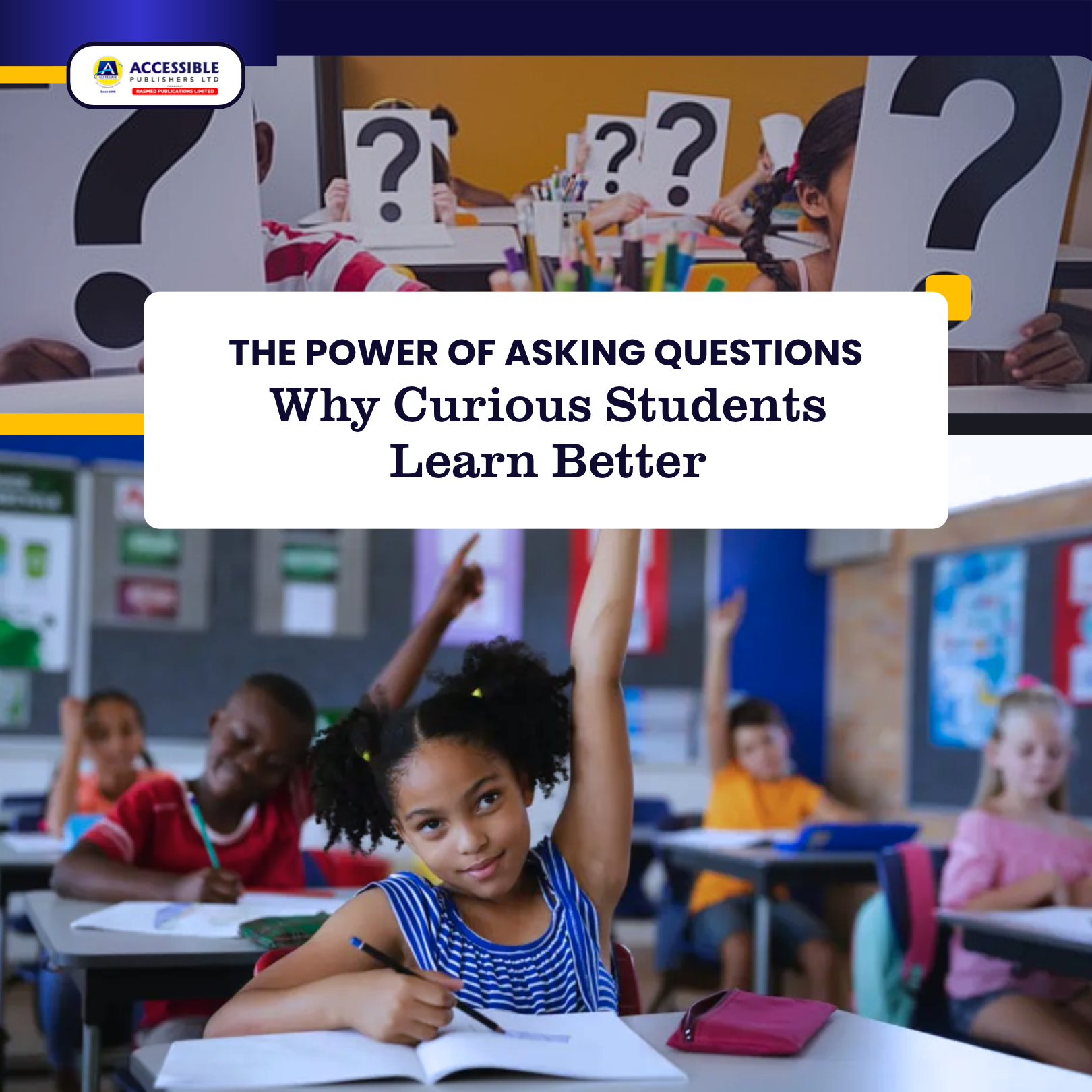
Why does the moon appear to follow us when we travel at night? How do plants make their food? Why must we learn mathematics if we may not use every formula in daily life? Asking Questions helps explore curiosity.
Every great discovery begins with Asking Questions. From the child who wants to know why the sky changes colour to the student who challenges a scientific theory, curiosity is often the first step towards meaningful learning.
In Nigerian classrooms, where teachers work hard to cover the curriculum, prepare students for examinations and ensure that learners understand their lessons, asking questions can sometimes take a back seat. Students may concentrate on copying notes, memorising definitions and preparing for tests without taking enough time to explore the ideas behind what they are learning.
However, learning is not just about receiving information; it is also about questioning, exploring and discovering meaning. A student who asks questions is actively engaging with a lesson rather than simply listening to it. Instead of accepting information at face value, such a learner seeks explanations, makes connections and develops a deeper understanding of the subject.
This is why curiosity matters in education. When students feel comfortable Asking Questions, they become more involved in learning. They identify gaps in understanding and develop the confidence to explore ideas.
So, how does asking questions improve learning, why do some students hesitate to speak up, and what can teachers and parents do to nurture curiosity? Understanding the answers can help create a learning environment where students are encouraged not only to know the right answers but also to ask the right questions.
2. Why Asking Questions Is an Important Part of Learning
Asking questions is one of the most practical ways students can participate actively in their education. It helps them clarify information, examine ideas and take responsibility for understanding what they are taught.
Here are some important reasons questions should be encouraged in the classroom.
It helps students identify gaps in their understanding
A student may copy a note perfectly and still struggle to explain what it means. Without asking questions, that confusion may remain hidden until an examination reveals the problem.
For example, a student learning fractions may understand how to add two fractions with the same denominator but become confused when the denominators are different. Asking the teacher why the denominators must be made the same can help the student understand the principle behind the calculation.
Questions allow learners to address misunderstandings before they become bigger learning difficulties.
It encourages critical thinking
Education should equip students to think, evaluate information and make informed decisions, not merely memorise facts.
Questions such as “Why does this happen?”, “What evidence supports this explanation?” and “Could there be another way to solve this problem?” encourage learners to examine information more carefully.
This is particularly important in subjects such as Mathematics, Basic Science, Social Studies and Civic Education, where students need to understand relationships between ideas and apply what they know to different situations.
It makes learning more interactive
A classroom becomes more engaging when students contribute their thoughts, seek clarification and share observations. Instead of being passive listeners, they become active participants in the learning process.
For teachers, students’ questions also provide valuable feedback. A question can reveal which part of a lesson needs further explanation, allowing the teacher to adjust the lesson to meet learners’ needs.
It builds confidence and communication skills
As students practise asking questions, they learn to express their thoughts clearly, explain what they do not understand and engage in discussions with others.
Although some children may initially feel shy about speaking in front of their classmates, a supportive classroom can help them become more comfortable contributing to discussions.
Over time, this confidence can extend beyond schoolwork to interviews, presentations, group projects and everyday communication.
3. How Curiosity Helps Students Understand and Remember Lessons Better
Curiosity is more than the desire to know something. In education, it encourages learners to pay attention, investigate unfamiliar ideas and connect new information with what they already know.
When students are curious, learning becomes an active process of discovery.
Curiosity gives students a reason to pay attention
Imagine a teacher beginning a lesson on evaporation by asking, “Why does wet clothing dry faster when it is spread outside on a sunny, windy day?”
Students may begin thinking about their experiences at home, offering explanations and wondering what sunlight and wind have to do with drying clothes.
This simple question creates a reason to pay attention to the lesson. Students are no longer learning about evaporation as an isolated definition; they are trying to understand a familiar experience.
When lessons connect with questions learners genuinely want answered, the subject can become more meaningful and engaging.
It helps students connect new knowledge to what they already know
Students do not enter the classroom without knowledge. They bring experiences from their homes, communities, conversations, books and observations of the world around them.
Curiosity helps them connect these experiences with new concepts.
For example, a child who has watched a seed germinate in a container may be more interested in learning about plant growth in Basic Science. Questions about why the seed needs water, what happens underground and how the first leaves appear can help the child connect practical observations with scientific explanations.
These connections make abstract concepts easier to understand.
Asking questions supports memory and understanding
Memorisation has a place in education, but students often struggle to apply information when they have learnt it without understanding its meaning.
Asking questions encourages learners to explain ideas in their own words, compare concepts and think through how information works. These activities can strengthen understanding and make it easier to recall knowledge later.
For instance, rather than simply memorising the parts of a plant, a student who asks what each part does is more likely to understand how the roots, stem, leaves and flowers contribute to the plant’s life.
Teachers can support this process by asking students to explain their reasoning, provide examples and relate lessons to familiar situations.
Curiosity encourages independent exploration
A curious student does not always stop learning when the lesson ends. A classroom discussion about space may lead to reading a science book, exploring an educational website or asking a parent about the planets.
This willingness to investigate beyond the classroom helps students develop independent learning habits.
However, independent exploration should be guided by reliable information. Teachers and parents can help children distinguish between evidence-based explanations, opinions and misleading information, particularly when they use the internet for research.
4. What Stops Students from Asking Questions in Class?
Although questions are important for learning, not every student feels comfortable asking them. Sometimes, the problem is not a lack of curiosity but the environment in which the child is learning.
Understanding these barriers is the first step towards creating classrooms where students feel safe enough to speak.
Fear of making mistakes or being laughed at
One of the biggest reasons students remain silent is the fear of embarrassment.
A child may wonder whether a question is too simple or worry that classmates will laugh at them for not understanding something others appear to know.
When mistakes are treated as a source of shame, students may choose silence over clarification. Unfortunately, this can leave misconceptions uncorrected.
Teachers can address this by treating questions respectfully and showing students that asking for help is a normal part of learning.
The belief that asking questions shows weakness
Some learners believe that intelligent students should understand everything immediately. As a result, they may pretend to understand a lesson rather than admit that they are confused.
In reality, recognising what one does not understand is an important part of learning. A thoughtful question often shows that a student is paying attention and trying to make sense of a concept.
Parents and teachers should reinforce the idea that intelligence is not measured by knowing everything but also by being willing to learn.
Limited time and crowded classrooms
In some Nigerian schools, large class sizes, tight lesson schedules and pressure to complete the curriculum can make it difficult for teachers to give every student an opportunity to ask questions.
When lessons move quickly, students who need additional explanations may be left behind. Others may avoid interrupting because they do not want to delay the class.
Teachers can help by creating specific opportunities for questions, using short discussion periods and encouraging students to submit questions anonymously when necessary.
Fear of receiving a harsh response
A student’s willingness to ask questions can be influenced by how teachers and parents respond when they seek clarification.
Responses such as “You should know this already” or “Were you not listening?” may discourage children from speaking up in the future.
Although teachers sometimes need to manage difficult classroom situations, responding calmly and constructively can make a significant difference.
A child who receives encouragement after asking a question is more likely to participate again.
Lack of confidence in expressing thoughts
Some students understand what they want to know but struggle to put their thoughts into words. Others may need more time to process information before they can formulate a question.
Providing sentence starters such as “Could you explain why…?”, “What is the difference between…?” and “Can you give another example of…?” can help learners express themselves more confidently.
5. How Teachers and Parents Can Encourage Children to Ask More Questions
Curiosity can be nurtured. Teachers and parents do not need expensive equipment or complicated teaching methods to encourage children to become more inquisitive. What matters is creating opportunities for exploration and responding positively when questions arise.
Teachers should create a classroom where questions are welcome
Students are more likely to ask questions when they know their contributions will be treated with respect.
Teachers can establish a simple classroom rule: every genuine question deserves consideration, even when the answer seems obvious to others.
Instead of dismissing a question, a teacher can acknowledge it, provide an explanation or guide the student towards discovering the answer.
When a question is unrelated to the immediate lesson, the teacher can acknowledge the student’s curiosity and arrange to revisit it later if time permits.
Ask open-ended questions during lessons
Questions that require more than a yes-or-no answer encourage students to think deeply and explain their reasoning.
For example, instead of asking only, “Do plants need sunlight?”, a teacher could ask, “What do you think would happen if a plant were kept in a dark room for several weeks?”
Students can share predictions, explain their reasoning and compare their ideas with scientific evidence.
Other useful questions include:
- What do you think caused this to happen?
- How would you solve this problem differently?
- What evidence supports your answer?
- What would happen if one part of this process changed?
- Can you connect this lesson to something you have seen at home or in your community?
These questions encourage students to participate in learning rather than simply wait for the teacher to provide answers.
Give students enough time to think
Not every child can respond immediately after a question is asked. Some students need time to organise their thoughts, recall information or find the right words.
Teachers can allow a few seconds of thinking time before inviting responses. Pair discussions can also help shy learners practise their ideas with a classmate before sharing them with the whole class.
This approach gives more students an opportunity to participate, rather than allowing only the quickest learners to answer.
Encourage questions at home
Parents play an important role in developing children’s curiosity. Everyday activities such as cooking, shopping, gardening and travelling can become opportunities for learning.
A parent preparing a meal might ask, “Why do you think water boils faster in some situations than others?” A trip to the market could prompt questions about measurement, money, prices and budgeting.
Parents do not need to know the answer to every question. They can explore the answer with the child using age-appropriate books, educational resources and reliable websites.
This teaches children that learning is a continuous process that extends beyond the school environment.
Provide access to books and educational resources
Books introduce children to ideas, places, people and experiences they may not encounter in their everyday lives. They can also inspire questions that lead to further exploration.
Parents and teachers can encourage children to read storybooks, science books, biographies, history texts and other age-appropriate educational materials.
After reading, adults can ask questions such as, “What surprised you?”, “What would you like to know more about?” and “Was there anything in the story you did not understand?”
These conversations help children develop the habit of reading with curiosity rather than merely reading to finish a task.
Celebrate curiosity, not just correct answers
When praise is given only for correct answers, students may become more concerned about appearing intelligent than understanding a subject.
Teachers and parents can also recognise effort, thoughtful questions, careful reasoning and the willingness to investigate a problem.
A student who asks a useful question but struggles to find the answer should still be encouraged for showing initiative.
The goal is not to make children question everything without reason. It is to help them develop the judgement to ask meaningful questions, seek evidence and learn from reliable sources.
6. From Curious Questions to Confident, Independent Learners
The ability to ask questions is a valuable learning skill that can benefit students throughout their education and beyond.
When children learn to question ideas, seek explanations and explore unfamiliar concepts, they become better equipped to take responsibility for their learning. They begin to recognise when they need help, look for information independently and approach challenges with greater confidence.
These habits are useful far beyond the classroom. In higher education, students must investigate ideas and engage critically with information. In the workplace, people need to ask questions, solve problems and learn new skills. In everyday life, the ability to seek reliable information helps individuals make informed decisions.
For Nigerian schools, encouraging curiosity is an opportunity to build learning environments where students are not judged only by their ability to reproduce information but are also supported in developing understanding, creativity and independent thought.
Teachers can make room for questions during lessons, parents can encourage exploration at home, and school owners can support teaching practices that value active participation. Together, these efforts can help children see learning as something they participate in, rather than something that simply happens to them.
As the saying goes, “The important thing is not to stop questioning.” This thought, famously expressed by Albert Einstein, captures the value of maintaining curiosity throughout life.
Ultimately, a student’s question may seem small, but the learning it inspires can be significant. Every “why”, “how” and “what if” creates an opportunity to discover something new.
The more we encourage children to ask questions, the better we prepare them to think independently, learn confidently and approach the world with open minds.
Check out our literature catalogue to discover an array of titles that can help motivate children to keep turning the pages. It’s time to explore and embark on an enriching literary journey.
Click this link to learn more about us here!