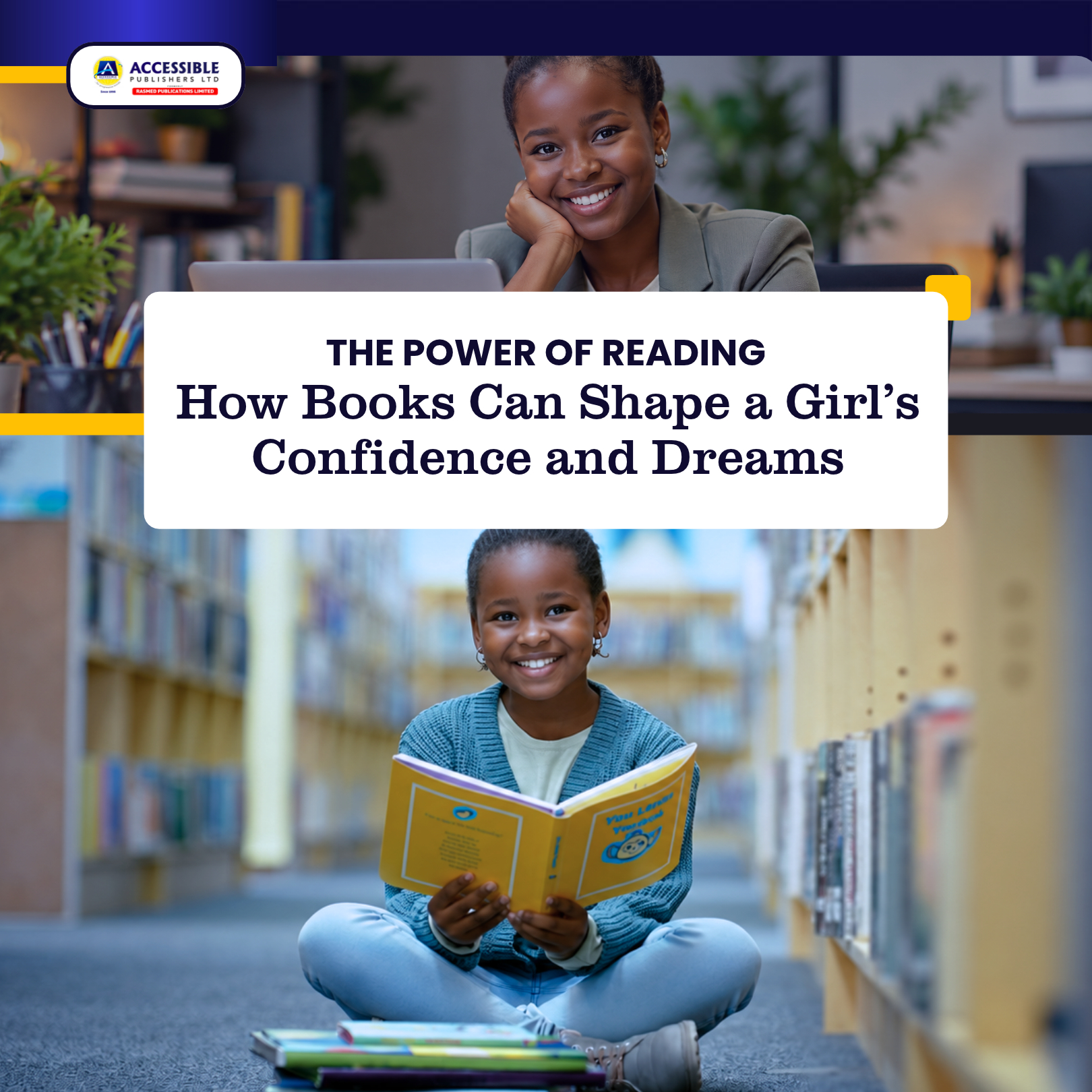
A girl opens a book, turns the first page and enters a world she has never seen before.
She meets characters who face challenges, make difficult choices, discover their strengths and sometimes achieve things they once thought were impossible. As she reads, something else begins to happen. She starts to ask questions and discovers new ideas. She finds words for her thoughts and, perhaps most importantly, begins to imagine what could be possible for her too.
This is part of the power of reading.
Books are more than sources of information. For children, they can be windows into different experiences and mirrors that help them understand themselves. For girls especially, access to diverse and inspiring stories can help them develop confidence, discover interests and imagine futures beyond the limits of what they already know.
Reading does not automatically determine who a girl will become. However, it can give her something valuable along the way: knowledge, language, imagination and the confidence to explore possibilities.
As Malala Yousafzai reminds us, “One child, one teacher, one book, one pen can change the world.”
When girls are encouraged to read widely and consistently, the benefits can reach far beyond academic performance.
Why Reading Matters in a Girl’s Development
Reading plays an important role in children’s intellectual, emotional and social development. It helps children understand language, build knowledge, communicate effectively and make sense of the world around them.
For girls, reading can also provide opportunities to encounter different perspectives, experiences and possibilities.
Reading builds knowledge
Every book introduces a child to something new.
A story about space may introduce her to astronomy. Biography may spark an interest in leadership. Books about an inventor may make science and technology feel more accessible. A story about another culture can help her understand people whose experiences differ from her own.
The more children read, the more knowledge they accumulate—and that knowledge can influence the questions they ask and the interests they develop.
Reading strengthens communication
A girl who reads regularly is exposed to new words, sentence structures and ways of expressing ideas.
Over time, this can help her communicate more clearly in conversations, classroom discussions, writing and other situations.
Being able to express an idea confidently is an important skill in school, the workplace and everyday life.
Reading develops imagination
Books allow children to travel beyond their immediate environment.
A child living in one part of Nigeria can read about another country, another time period or an entirely fictional world. Through stories, she can explore situations she may never encounter personally.
This ability to imagine different possibilities can encourage creativity and flexible thinking.
Reading can help children understand emotions
Stories often explore friendship, disappointment, courage, fear, failure, kindness and perseverance.
As girls encounter characters dealing with these experiences, they can begin to recognise and discuss emotions in themselves and others.
How Stories Can Help Girls Build Confidence and Believe in Themselves
Confidence does not appear overnight. It develops through experiences, encouragement, knowledge and the gradual understanding that challenges can be overcome.
Books can contribute to this process by giving girls characters they can learn from, relate to and discuss.
Seeing relatable characters matters
When girls encounter characters who look like them, share aspects of their experiences or face challenges they recognise, stories can help them feel seen.
A girl may read about a character who is shy but eventually finds her voice, struggles academically but keeps trying, or faces a difficult situation and discovers the courage to continue.
Such stories can create opportunities for reflection:
“What would I do in that situation?”
“Have I ever felt this way?”
“What can I learn from her?”
These conversations can help children think about their own strengths and choices.
Stories can make failure feel less frightening
Many children’s stories include characters who make mistakes before succeeding.
This can help children understand that failure does not have to be the end of the story.
A girl who sees a character struggle, learn and try again may become more comfortable with the idea that she does not have to be perfect before she can make progress.
Books can introduce positive role models
Biographies and stories about women in different professions can help girls discover examples of people who pursued their interests, overcame challenges and contributed to their communities.
These role models can broaden a child’s understanding of what women can do and the different paths she might explore as she grows.
How Books Can Expand a Girl’s Dreams and Help Her Imagine New Possibilities
Children can only imagine many possibilities when they have opportunities to encounter them.
A girl may not know that a particular career exists until she reads about it. She may not consider herself capable of something until she encounters a character or real-life woman doing it.
Books can therefore help expand the boundaries of what children consider possible.
Books introduce girls to different careers
Reading can expose girls to professions such as engineering, medicine, architecture, technology, journalism, agriculture, law, research, entrepreneurship, publishing, creative arts and many others.
A girl who reads about a woman building technology may become curious about coding. Another who reads about a scientist may begin asking questions about the natural world.
The story does not decide her career. It simply introduces another possibility.
Books encourage children to dream beyond their immediate surroundings
A child’s environment can influence what she believes is possible.
Books can broaden that environment by introducing different places, people and experiences.
Through reading, a girl can meet women who live in different countries, work in different industries, solve different problems and pursue different ambitions.
This can encourage her to think beyond what she already knows.
Stories can encourage ambition while teaching perseverance
Dreams are important, but children also need to understand that meaningful goals often require patience, learning and effort.
Stories can demonstrate this by showing characters working towards their goals, encountering setbacks and continuing to learn.
This helps children connect dreaming with action.
The Reading Skills That Can Prepare Girls for School, Work and Life
The value of reading extends beyond finishing books. Regular reading helps children develop skills that can remain useful throughout life.
Comprehension
Reading comprehension enables children to understand, interpret and respond to information.
This skill is important across subjects in school and later in professional environments.
Vocabulary
Exposure to new words gives children more tools for expressing their thoughts and understanding complex ideas.
A strong vocabulary can support both written and verbal communication.
Critical thinking
Reading encourages children to ask questions about what they encounter.
Who is telling the story? Why did a character make that decision? Is this information reliable? What evidence supports this idea?
These questions encourage children to think beyond simply accepting information.
Concentration
In a world filled with notifications and distractions, spending time with a book can encourage children to focus on one activity for an extended period.
Developing this ability can benefit learning and other tasks that require sustained attention.
Writing and communication
Reading exposes children to different ways of organising and expressing ideas.
Over time, this exposure can support their own writing and communication skills.
Empathy
Stories allow readers to encounter experiences from different perspectives.
A girl may read about someone who has a completely different background, challenge or way of seeing the world. This can encourage her to understand that people can experience the same situation differently.
How Parents, Teachers and Schools Can Build a Reading Culture That Helps Girls Thrive
Creating confident readers requires more than telling children to read. Adults need to make reading accessible, enjoyable and relevant.
Parents can make reading part of everyday life
Parents can set aside regular reading time at home and allow children to choose some of the books they want to explore.
Reading together, discussing stories and asking children what they think about a character can make reading more interactive.
Parents should also allow girls to explore different genres. Fiction, biographies, science books, history, poetry, culture, adventure and educational books can all contribute to a broad reading experience.
Teachers can connect books to real life
Teachers can encourage girls to discuss what they read rather than focusing only on whether they can remember the details.
Questions such as “What would you have done?”, “What did this character teach you?” and “How does this relate to something we see around us?” can turn reading into a deeper learning experience.
Schools can create welcoming reading spaces
A school library or reading corner should feel inviting rather than intimidating.
Schools can organise reading clubs, book discussions, storytelling sessions, reading challenges and author visits to make books a visible part of school life.
Give girls access to diverse books
Children need access to books that reflect different people, cultures, careers, experiences and ideas.
For girls, this includes stories that allow them to see women and girls as thinkers, creators, leaders, scientists, entrepreneurs, professionals, artists, innovators and active contributors to their communities.
Let children see adults reading
Children notice what adults do.
When parents and teachers read for pleasure and learning, they demonstrate that reading is not simply a school requirement. It is a lifelong habit.
Don’t turn every book into an assignment
Reading should not always feel like another examination.
Sometimes, a child should simply be allowed to enjoy a story.
Let her laugh at a funny character, become curious about an unfamiliar place, wonder what will happen next or talk excitedly about her favourite part.
Enjoyment can be one of the strongest reasons a child keeps reading.
Conclusion
A book can be many things to a young girl.
It can be a teacher, introducing her to new knowledge or a mirror, helping her understand herself. A window, showing her lives and possibilities beyond her immediate environment. And sometimes, it can be the first place where she encounters a dream she never knew she could have.
That is why encouraging girls to read is about more than improving academic performance.
It is about giving them opportunities to learn, imagine, question, communicate and dream.
Parents, teachers and schools all have a role to play in making those opportunities available.
The next time a girl picks up a book, remember that she may not simply be reading a story.
She may be discovering a new idea.
And sometimes, a dream begins with a page.
Check out our literature catalogue to discover an array of titles that can help motivate children to keep turning the pages. It’s time to explore and embark on an enriching literary journey.
Click this link to learn more about us here!