
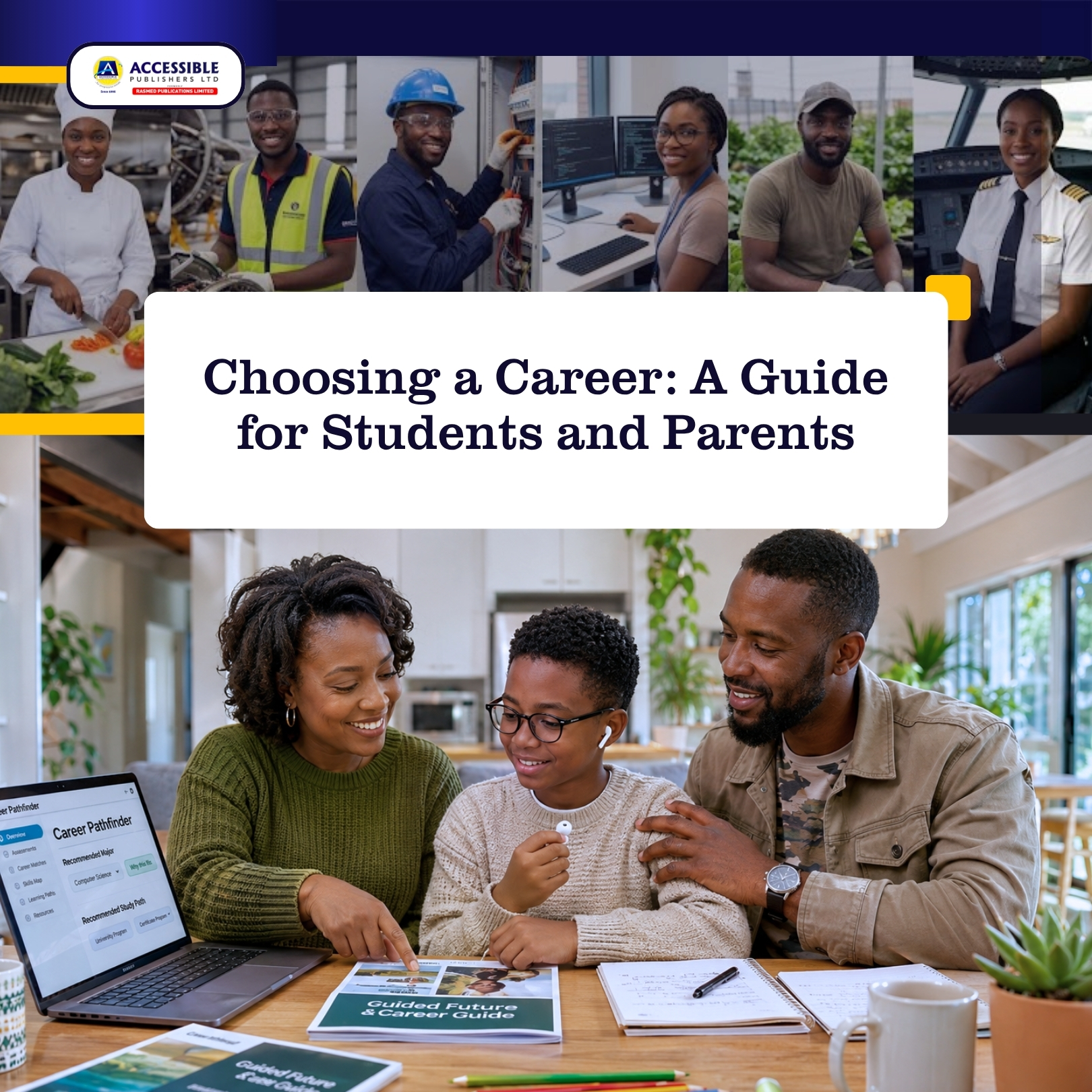
Choosing a career is one of the most important decisions a young person will make. It shapes education, lifestyle, financial future, and overall fulfilment. The choice influences daily routines, study paths, and long term goals for many families. This reality guides conversations early.
Yet, for many Nigerian families, conversations about career choices are not straightforward. They involve expectations about stability, prestige, and the benefits of professional status. Clear dialogue helps align dreams with practical possibilities. Such discussions reduce confusion and strengthen family support.
Students and Parents may disagree about pursuing music, art, writing, or fashion design versus medicine, law, engineering, or other secure fields. Ultimately, open discussions support informed decisions that respect both passion and practicality. The outcome strengthens confidence as they move forward together.
For Students and Parents, it can be frustrating when their interests and aspirations aren’t taken seriously.
Additionally, it remains difficult to support a career path if they are uncertain about financial prospects.
Both sides often have good intentions, but clashes over expectations turn guidance into family tension rather than opportunity.
However, we should not reduce career decisions to a choice between pleasing parents and following personal interests. They should be guided by self-awareness, relevant information, practical considerations and open communication.
Firstly, how can Students and Parents discover career paths that align with abilities and interests? This guide helps families feel confident about their children’s future. It also explains how families can navigate career expectations, understand one another, and decide together.
The Dynamics Between Students and Parents
Why Parents and Students Often Want Different Things
The disagreement between parents and students over career choices often comes from their different experiences, priorities and understanding of the world.
Parents may have spent years working hard to provide their children with opportunities they never had. Naturally, they want those efforts to lead to a future where their children enjoy financial stability, professional respect and a comfortable life. As a result, they may encourage careers they believe offer better job security, reliable income and social recognition.
In Nigeria, professions such as medicine, law, engineering and accounting have traditionally enjoyed considerable respect. Some parents may therefore struggle to understand why their children would prefer careers in creative arts, entertainment, technology, sports, agriculture or entrepreneurship.
Students, on the other hand, are growing up in a world where career opportunities are expanding beyond traditional professions. Digital technology, social media, artificial intelligence, creative industries and remote work have introduced new possibilities that previous generations may not have fully experienced.
A student who wants to become a content creator, software developer, animator or game designer may see exciting opportunities in these fields, while their parents may view them as uncertain or unconventional.
Another reason for these disagreements is the assumption that academic performance should determine career choice. A student who performs exceptionally well in science subjects may be expected to study medicine, even when their strongest interest lies elsewhere.
Ultimately, the disagreement is often not about who wants the best for the student. It is about how each generation defines a successful and fulfilling career.
Understanding Each Side: What Parents Worry About and What Students Want
Before families can find common ground, they need to understand the concerns and expectations behind their different positions.
What parents worry about
For many parents, choosing a career is closely connected to their children’s future security. Their concerns may include:
- Financial stability: Parents want their children to pursue careers that can provide a sustainable income and help them become financially independent.
- Job opportunities: They may worry about whether the chosen profession has enough employment opportunities, particularly in Nigeria’s competitive labour market.
- Social acceptance: Some parents place importance on careers that are widely respected and recognised in society.
- Long-term security: They want to know whether the profession will remain relevant and provide opportunities for growth over time.
- Fear of failure: Having invested time and resources in their children’s education, parents may be afraid that an unconventional career choice could lead to disappointment or financial hardship.
These concerns are often rooted in love and a desire to protect their children. However, protection should not prevent young people from exploring opportunities that may be better suited to their abilities.
What students want
Students also have legitimate reasons for wanting a say in their career decisions. Their expectations may include:
- Personal fulfilment: They want to pursue work they find interesting, meaningful and enjoyable.
- Opportunity to use their talents: Some students recognise their strengths in areas that may not align with traditional academic or professional expectations.
- Independence: They want to feel that their future is shaped by their abilities, interests and personal ambitions.
- Room for creativity and innovation: Many young people are attracted to careers that allow them to create, solve problems and explore new ideas.
- A sense of purpose: They want to build careers that reflect their values and the kind of impact they hope to make.
Neither perspective should be dismissed. Parents bring experience and practical concerns, while students bring personal knowledge of their interests, strengths and aspirations. A good career decision should take both into account.
How Students Can Discover Their Strengths, Interests and Career Options
Choosing a career should begin with self-discovery rather than pressure from friends, family or society. Students need to understand what they are good at, what interests them and the opportunities available within different professions.
Here are practical ways to begin:
Identify personal strengths and interests
Students should pay attention to the subjects, activities and tasks they naturally enjoy. Are they good at solving mathematical problems, writing, drawing, organising events, communicating with people or fixing things?
Their interests outside the classroom can also provide useful clues. A student who enjoys creating videos may have an interest in filmmaking, digital marketing or media production. Someone who enjoys helping others may want to explore healthcare, education, counselling or social work.
Explore different career options
Students should not limit themselves to the professions they frequently hear about. There are numerous career opportunities across different sectors, including:
- Science and healthcare: Medicine, nursing, pharmacy, laboratory science and physiotherapy.
- Technology: Software development, cybersecurity, data analysis, artificial intelligence and computer engineering.
- Education: Teaching, educational administration, curriculum development and educational technology.
- Creative industries: Graphic design, animation, photography, filmmaking, music and fashion design.
- Business and finance: Accounting, marketing, entrepreneurship, banking and human resource management.
- Agriculture: Agricultural engineering, animal science, agribusiness and food technology.
Exploring these options helps students understand that there are many ways to build successful careers beyond a few popular professions.
Seek guidance from experienced people
Students can learn a lot by speaking with teachers, career counsellors, professionals and people already working in fields that interest them.
They can ask questions about the qualifications required, everyday responsibilities, challenges, earning opportunities and possible career progression. This gives them a realistic understanding of what pursuing a particular profession involves.
Take advantage of career assessment and guidance
Career assessment exercises can help students identify their interests, abilities and personality preferences. Schools can also organise career talks, mentorship sessions and career days to expose learners to different professions.
However, assessment results should be treated as guidance rather than a final verdict. No single test should determine what a student can or cannot become.
Understand the educational requirements
Having a career interest is a good starting point, but students must also understand the academic qualifications, skills and training required to pursue it.
For instance, students interested in studying courses in Nigerian universities should familiarise themselves with relevant admission requirements, including WAEC/NECO subject combinations, JAMB UTME requirements and any additional departmental criteria.
The more informed students are, the better prepared they will be to explain and defend their career choices.
How to Hold an Honest Family Conversation Without It Turning Into an Argument
Career conversations should be opportunities for learning and understanding, not competitions over who has the final say.
When parents and students approach these discussions with patience and respect, they are more likely to reach a decision that everyone can support.
Here are some ways to make the conversation productive:
Choose the right time to talk
Career discussions should not happen in the middle of an argument or when either party is upset. Families should create a relaxed environment where everyone can express their thoughts without feeling pressured.
Allow students to explain their interests
Parents should give their children the opportunity to explain why they are interested in a particular career. Rather than dismissing an option immediately, they should ask questions that help them understand the student’s motivation.
For example, instead of saying, “You cannot make a living from that,” a parent could ask, “What opportunities are available in that field, and how do you plan to build a career in it?”
Encourage students to present facts, not just emotions
Students should understand that saying “I like it” may not be enough to convince concerned parents. They should be prepared to discuss the qualifications required, potential career opportunities, financial prospects and possible challenges.
Demonstrating that they have researched their preferred profession shows maturity and seriousness.
Parents should share their concerns without imposing decisions
Parents should communicate their fears and expectations honestly without making their children feel guilty for having different ambitions.
Instead of insisting on a particular profession, they can explain why they consider certain career paths more secure and encourage their children to explore the available evidence.
Listen without interrupting or judging
Both parties should be willing to listen. A student’s dream should not automatically be considered unrealistic, just as a parent’s advice should not automatically be viewed as an attempt to control their future.
Respectful communication creates room for compromise and better decision-making.
Finding Common Ground and Making a Decision Together
Finding common ground does not mean that parents must abandon their concerns or that students must give up their dreams. It means identifying a career path that considers personal interests, individual abilities, available opportunities and practical realities.
Families can begin by identifying what matters most to both sides. For instance, if a student is interested in music production while their parents are concerned about financial stability, they can explore the business and technology aspects of the music industry, including sound engineering, music technology and production management.
Similarly, a student interested in fashion could explore fashion design, textile technology, fashion merchandising or fashion entrepreneurship.
These possibilities demonstrate that a career interest can sometimes be approached from different angles without completely abandoning what the student enjoys.
Families should also consider the following:
- Research the career’s prospects: Examine current opportunities, earning potential, professional requirements and possible challenges.
- Consider transferable skills: Communication, problem-solving, digital literacy, leadership and critical thinking are useful across many professions.
- Develop a practical plan: Identify the relevant subjects, qualifications, institutions, training opportunities and resources required.
- Remain open to adjustments: Career interests may change as students gain more knowledge and experience. Choosing a career does not mean that every future decision is permanently fixed.
- Review progress together: Parents can support their children by checking in on their goals, academic progress and skill development without creating unnecessary pressure.
Most importantly, students should understand that having the freedom to choose a career also comes with the responsibility to work towards their goals. Likewise, parents should recognise that their role is not simply to choose a profession for their children but to provide the guidance, encouragement and support they need to make informed decisions.
Conclusion
Choosing a career should be a journey of discovery, not a battle between parental expectations and personal ambitions. While parents have valuable experiences and concerns to share, students also deserve the opportunity to explore their abilities, interests and aspirations.
The best career decisions are often made when families combine parental guidance with students’ self-awareness and access to accurate information. With open communication, proper research and a willingness to understand different perspectives, families can make decisions that are both realistic and fulfilling.
As Nelson Mandela once said, “Education is the most powerful weapon which you can use to change the world.” Helping young people make informed career choices is one way of ensuring that the education they receive prepares them not just for examinations, but for meaningful contributions to society.
Parents, teachers and schools all have a role to play in this process. By exposing students to different professions, encouraging their talents and providing the right guidance, we can help them build careers that reflect their potential and prepare them for the future.
Check out our literature catalogue to discover an array of titles that can help motivate children to keep turning the pages. It’s time to explore and embark on an enriching literary journey.
Click this link to learn more about us here!AI in Education