School breaks are often greeted with excitement by children and relief by parents and teachers. It is a welcome pause from the routines of early mornings, homework schedules, and classroom activities. Yet, while these short breaks provide much-needed rest, they can also become periods where children disconnect completely from learning.
The truth is, learning should not be limited to the four walls of a classroom. Every moment presents an opportunity for a child to grow intellectually, socially, and creatively. Short school breaks, whether mid-term holidays, public holiday stretches, or a few days off between sessions, can be transformed into meaningful periods of continued development.
As the popular saying goes, “Education is not the filling of a pail, but the lighting of a fire.” The goal during breaks is not to overwhelm children with academic tasks, but to keep that fire of curiosity and learning burning.
In this article, we will explore five smart ways parents, teachers, and school owners can keep children learning during short school breaks while still allowing them to enjoy their time off.
The Value of School Breaks
Before discussing how to keep children learning, it is important to understand why school breaks matter.
Short breaks are essential for children’s mental and emotional well-being. They offer time to rest, recharge, and return to school refreshed. Constant academic pressure without moments of rest can lead to fatigue, reduced concentration, and loss of motivation.
Breaks also give children the opportunity to explore interests beyond the classroom. This may include hobbies, creative activities, family bonding, and practical life experiences that contribute to holistic development.
However, while rest is important, a complete pause from intellectual engagement can sometimes cause children to lose momentum. Skills such as reading fluency, problem-solving ability, and memory retention improve with consistency. This is why maintaining a gentle learning rhythm during breaks is highly beneficial.
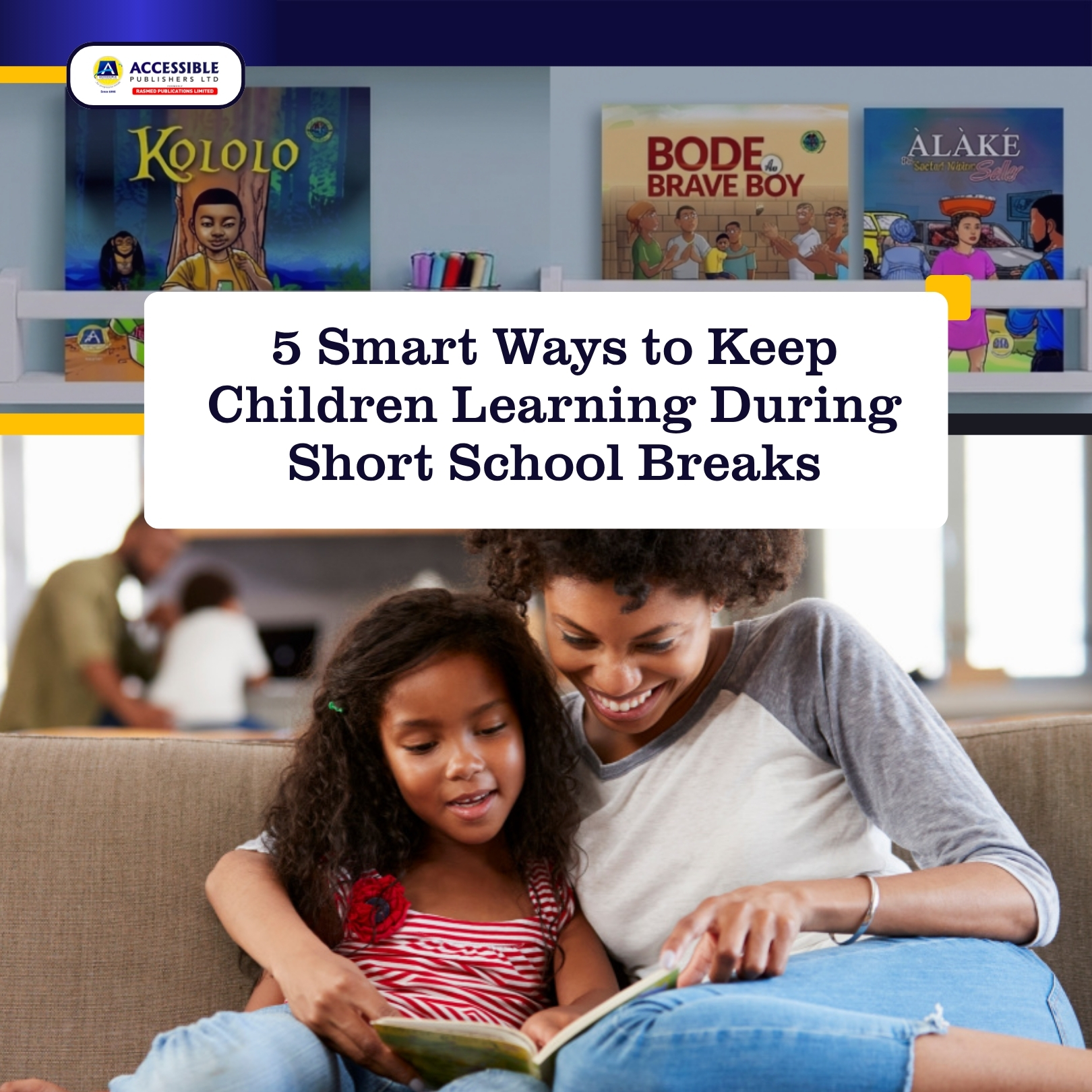
5 Smart Ways to Keep Children Learning During Short School Breaks
1. Encourage Daily Reading Time
One of the easiest and most effective ways to keep children learning is through reading.
Set aside 20 to 30 minutes each day for reading activities. This could include storybooks, educational books, magazines, or age-appropriate novels. For younger children, picture books and phonics readers are excellent choices, while older students can benefit from literature texts and subject-based revision materials.
Reading improves vocabulary, comprehension, imagination, and critical thinking.
Parents can make this more engaging by asking simple questions after reading:
- What did you learn from the story?
- Who was your favourite character?
- What would you have done differently?
This helps children move beyond passive reading into active thinking.
“Reading is to the mind what exercise is to the body.”
For Nigerian students, especially, exposing them to curriculum-aligned books during breaks can help them stay prepared for upcoming school activities.
2. Turn Everyday Activities into Learning Moments
Learning does not always have to look like formal study.
Simple daily activities at home can become powerful educational tools.
For example:
- Cooking can teach measurement, fractions, and sequencing.
- Shopping can teach budgeting, arithmetic, and decision-making.
- Gardening can introduce science concepts like plant growth.
- Watching educational documentaries can improve general knowledge.
Parents and caregivers should intentionally involve children in these experiences.
A short trip to the market, for instance, can become a mathematics lesson where children calculate total costs, estimate change, and compare prices.
This practical learning method helps children connect classroom knowledge with real-life situations.
3. Use Educational Games and Puzzles
Children naturally enjoy play, and smart learning during breaks should leverage that.
Educational games help children develop cognitive skills while having fun. These can include:
- Word search puzzles
- Scrabble
- Number games
- Memory cards
- Building blocks
- Board games
- Educational mobile apps
Games improve concentration, strategic thinking, creativity, and problem-solving.
Teachers and school owners can also recommend specific games that reinforce classroom concepts, especially in subjects like Mathematics, English, and Basic Science.
The key is to ensure that learning feels enjoyable rather than forced.
4. Introduce Creative Writing and Storytelling
Short school breaks are an excellent time to nurture children’s creativity.
Encourage them to write short stories, poems, diary entries, or even simple essays about their holiday experiences.
For younger children, storytelling sessions can be especially effective. Parents can begin a story and ask the child to continue it. This strengthens imagination, language skills, and confidence in expression.
For example, a child can be asked to write on topics such as:
- How I spent my school break
- My dream profession
- A day in the life of my favourite hero
This not only keeps their writing skills sharp but also helps teachers assess expression and grammar when school resumes.
5. Create a Light Revision Schedule
A short and flexible revision plan can help children stay academically connected without taking away the joy of the holiday.
This does not need to be rigid or stressful.
A simple timetable of 30–45 minutes daily covering one or two subjects is often enough.
For example:
- Monday: Mathematics practice
- Tuesday: Reading and spelling
- Wednesday: Science activities
- Thursday: Writing exercise
- Friday: Quiz or educational game
Consistency matters more than duration.
Parents should focus on a light revision of previously taught topics rather than introducing completely new concepts.
This helps children retain what they have learned and return to school with confidence.
Importance of Keeping the Learning Flow Alive
Maintaining learning during short school breaks offers several long-term benefits.
First, it reduces learning loss. Children are less likely to forget concepts they were taught before the break.
Second, it strengthens discipline and study habits. When children remain mentally active, it becomes easier for them to transition back into school routines.
Third, it boosts confidence. A child who continues reading, writing, and revising during breaks often resumes school feeling prepared and motivated.
For school owners and teachers, encouraging this culture can also improve overall academic performance when classes resume.
Most importantly, it helps children understand that learning is a lifelong process, not something restricted to school calendars.
Conclusion
Short school breaks should be a healthy balance of rest and continued growth.
While children deserve time to relax and enjoy themselves, it is equally important to keep their minds active in smart and engaging ways.
Through daily reading, practical life lessons, educational games, creative writing, and light revision, parents and educators can ensure that children continue to grow academically even outside the classroom.
The aim is not to burden them, but to sustain curiosity, confidence, and consistency.
After all, every break can become an opportunity to build brighter learners and future leaders.
Check out our literature catalogue to discover an array of titles that can help motivate children to keep turning the pages. It’s time to explore and embark on an enriching literary journey.
Click this link to learn more about us here!