
“Thousands have lived without love, not one without water.” This is a stark reminder that while many human needs may be deferred, water is not one of them. But what does it truly mean to learn in an environment where something as basic as clean water is not guaranteed?
Water is indispensable. However, for millions of people around the world, access to clean water remains uncertain, and the consequences are far-reaching: poor health, interrupted education, and deepening inequality. Schools, as centres of learning and socialisation, are uniquely positioned to shape attitudes and behaviours around water, sanitation, and hygiene (WASH).
The world prepares to mark World Water Day, and the question is no longer whether schools should be involved, but how actively they can lead the charge. This blog explores and decodes the 2026 theme for World Water Day, examines the importance of clean water for healthy living, and outlines five practical ways schools can promote clean water and hygiene.
Decoding the 2026 Theme for World Water Day
The 2026 World Water Day theme, “Water and Gender,” underscores a critical but often overlooked dimension of the global water crisis: inequality. Observed annually on 22 March, World Water Day provides an opportunity to reflect on the deeper social realities tied to water access. At its core, the 2026 theme draws attention to how women and girls disproportionately bear the burden of water scarcity. The campaign slogan, “Where water flows, equality grows,” reinforces a powerful idea: access to clean water is not merely a health issue; it is a matter of dignity, opportunity, and social justice.
For schools, this theme is a clear call to action. It challenges educational institutions not only to provide clean water but to foster inclusive systems where every child, regardless of gender, can benefit equally.
Importance of Clean Water for Healthy Living
Clean water is foundational to human survival, but its importance extends beyond basic hydration. It is directly linked to sanitation, disease prevention, and overall well-being. Contaminated water remains a leading cause of illnesses such as cholera and diarrhoea, particularly among children. Globally, billions still lack access to safe drinking water, reinforcing cycles of poverty and poor health.
In the context of Nigerian schools, the picture is particularly stark: only about 11 per cent of schools nationwide have access to basic water, sanitation, and hygiene services, meaning the vast majority operate without reliable clean water, safe toilets, or handwashing facilities. This deficit fuels absenteeism and exposes children to preventable diseases like cholera and malaria, with girls especially at risk of missing school due to inadequate hygiene infrastructure.
Poor WASH conditions in schools contribute to illness, lower enrolment, poorer concentration, and reduced academic performance. Ensuring access to clean water in educational settings is therefore not just a matter of health; it is a prerequisite for learning, equity, and long-term development. Ultimately, without water and hygiene, education itself is compromised.
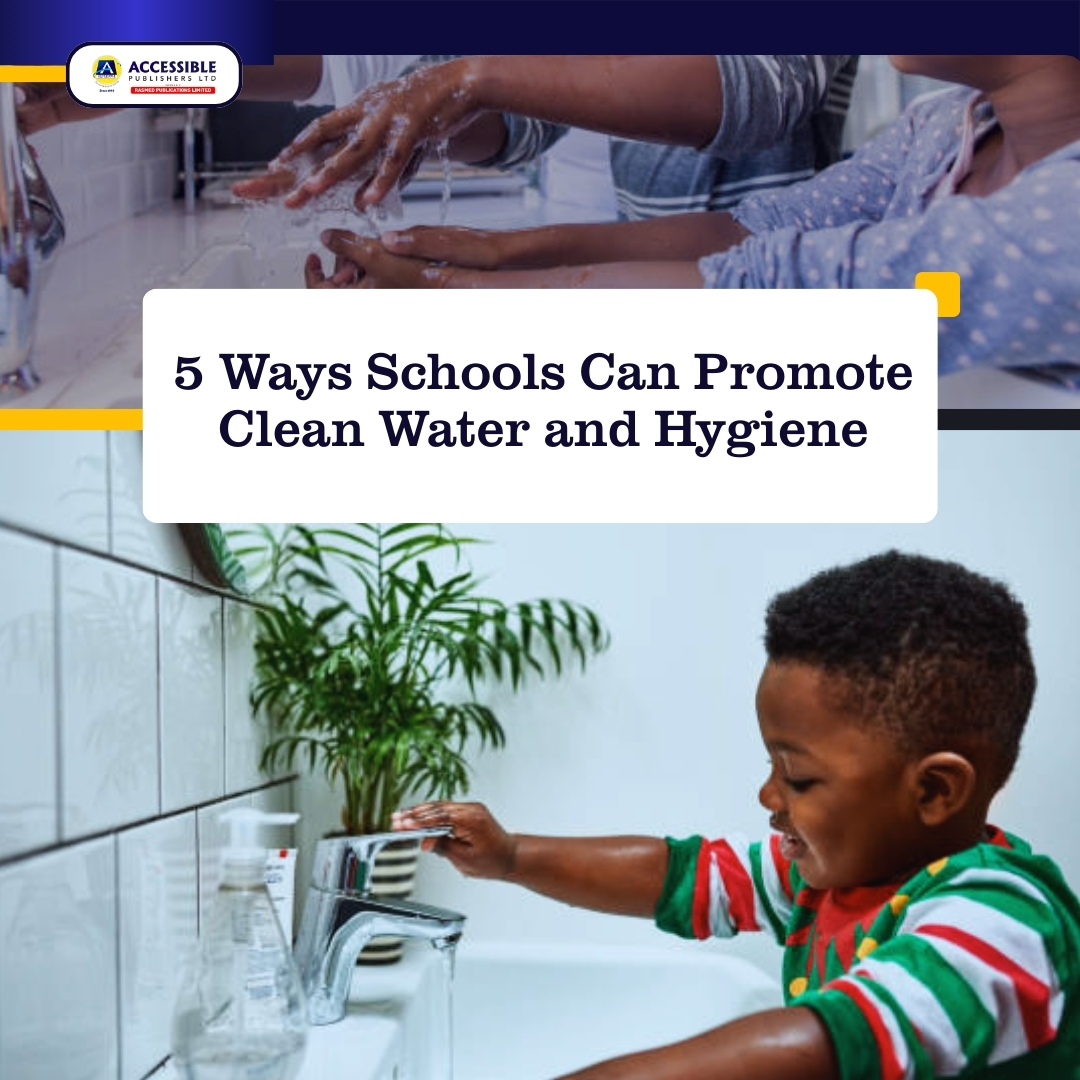
5 Ways Schools Can Promote Clean Water and Hygiene
Here are five practical ways schools can take the lead in promoting clean water and hygiene, empowering students to stay healthy and thrive academically.
1. Integrate Water and Hygiene Education into the Curriculum
Knowledge shapes behaviour. Schools should go beyond occasional talks and embed water, sanitation, and hygiene topics into subjects like science, social studies, and civic education. This should be prioritised.
2. Provide Functional Water and Sanitation Facilities
It is not enough to teach hygiene; schools must model it. This means ensuring access to safe drinking water, clean toilets, and handwashing stations with soap.
3. Promote Handwashing Culture
Handwashing is one of the simplest and most effective ways to prevent disease. Schools can institutionalise this by creating daily routines before meals, after toilet use, and after play. Simple interventions, such as designated handwashing times, can significantly reduce the spread of infections.
4. Encourage Student-Led Water Initiatives
Students should not just be passive recipients; they should be active participants. Environmental clubs, hygiene ambassadors, and peer educators can drive awareness campaigns within and beyond the school.
This approach builds leadership while ensuring that the message spreads organically among young people.
5. Engage the Wider Community
Schools do not exist in isolation. By partnering with parents, local organisations, and community leaders, schools can extend water and hygiene practices beyond the classroom.
Conclusion
The conversation around clean water is no longer confined to policy rooms or international summits; it begins in everyday spaces like schools. In the spirit of the 2026 World Water Day theme, promoting clean water is also about promoting equality. Here, the call is simple: when it flows freely and safely, so too does the potential of every child.
Check out our literature catalogue to discover an array of titles that can help motivate children to keep turning the pages. It’s time to explore and embark on an enriching literary journey.
Click this link to learn more about us here!